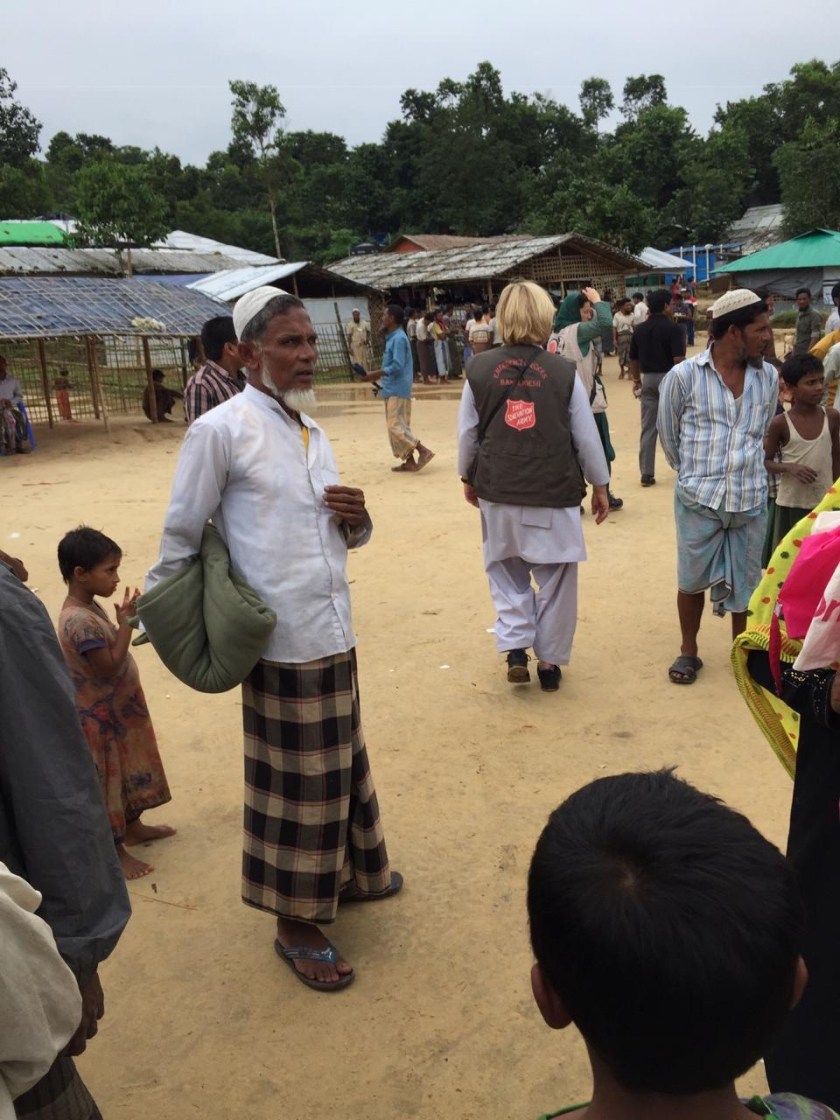
 This week we have spent time reviewing our Refugee Response Programme to the Rohingya people currently living in sprawling refugee camps in Bangladesh.
Initially when the Solar Light Project was set up, its aim was to provide light for people to safely carry out their daily routines, especially in the evenings, using sustainable and clean energy. In our review, families spoke of the benefit of being able to cook together, eat together, pray together and talk together. Women told us about how they felt much more protected at night time, the light providing at least some level of defence against men who would sexually harass, assault and abuse them. Thousands of children are still separated from their parents or primary caregivers and are living in child headed households. They told us they felt safer having the light on at night as they drifted off to sleep, just like many kids around the world. It also eased the thought of potential violence and trafficking. People told us they did not need to like fires or use kerosene in their makeshift homes to be able to see, thus preventing potential actions and injuries. Our project fell in the ‘Protection’ category; this was the purpose of the whole project and given the positive feedback from everyone, we were feeling rather satisfied with ourselves.
Then this! One man told us that that night time was a time of significant psychological stress for many people in the camp due to their experience in Myanmar. Most of the violence, the murders, the rapes had taken place in darkness. He told us he was anxious at night time. He humbly told me how the simple light we had supplied helped relieve and avoid psychological stresses for him and many other who had lost family members in the night.
Often we are so busy trying to meet the immediate practical needs of people who are refugees / homeless / victims / (add a range of categories) here, we forget that first and foremost they are people. In not recognizing their basic humanity, we forget and devalue their feelings, their relationships and their pain. We rob people of their dignity. We somehow make out that they are some sort of subcategory, less worthy and less vulnerable. The trauma was clearly so enormous for many. I talked to one women who, while she was hiding, watched as her husband was blindfolded, beaten and beheaded. Pain was etched all over her face and I was holding back tears as she spoke. What became clear from my conversation with this mother was that the Rohingya refugees are suffering from flashbacks, trauma anxiety, agitation, acute stress, recurring nightmares, guilt, sometimes not being able to sleep or eat. Others could not speak at all. As one organisation described the masses of people living in the camp; they are a distressed population.
When you dig a bit further there are many different types of trauma experienced by individuals. We heard some truly horrific stories. Then there is the collective trauma the Rohingya refugees face including displacement, being in limbo and not getting a clear message about the future and, according to a study by the IOM working with refugees, 40 percent of refugees cited “not being recognised as citizens” as psychologically destabilising
I am no expert in this field, but mental health and emotional well-being, like many places around the world, seems a very neglected and stigmatised discussion in Bangladesh generally, where it seems there is little by way of awareness, national policy or budget allocation for mental health care. When you couple this together with the conditions everyone is confronted with in the Refugee Camp, it is no surprise that most of us working in the camps dealt with the immediate needs: basic shelter, food and water. It is the easier option. The man we interviewed told us that Roningya people do not seek help citing mental health problems. He advised that he came from a culture where mental pain, depression and trauma are never talked about. There is no pressure from anywhere really to consider emotional wellbeing.
When you arrive in the camp, you cannot helped but be touched by squalid, overcrowded conditions, where people struggle to access food and water, and essentially they are trapped. And then you see that more people are still arriving. Of course, you want to do something and I for one am proud that The Salvation Army responded in a small but effective way.
But looking back, we wonder whether we could have added another component, something that was more relational, to this project as it would have tied in nicely with the solar lamp project. Our organisational value in Bangladesh stresses our holistic approach, so we need to look beyond the immediate / physical needs in emergency situations and see if there is any way we can also provide psychosocial and spiritual support to those we have assisted and built relationships with. I have learnt this week that a more progressive and holistic effort is required in designing our emergency response programmes. It was a hard but good lesson to learn. We are well-positioned to provide essential psychosocial and spiritual support.
The situation is still pretty desperate. The people in the camp, stuck and becoming increasingly restless with nowhere to go. Somehow we need to find a way to stay with them, to support them practically and psychologically and to make sure they know they are not forgotten and that we still care.

 BanglaBradburys
Thank you for asking questions, for listening, and for caring. May this info shape your next encounters with people who have value and who matter.
LikeLike